Why Is Your Verification SMS Delayed? A Hands-On Troubleshooting Guide

Why is the verification text message delayed? A practical guide to troubleshooting.
This message didn't arrive because your number is correct. Perhaps a service or carrier didn't allow it to go through, or maybe it arrived too late for the program to see it in your inbox. In this case, there's nothing you can do to resend the message. And if you try to resend it, your phone will block all messages, so avoid doing that. In fact, the worst thing you can do is try to resend it repeatedly. Your phone will likely block all messages, or the program might consider too many messages as suspicious and ignore them all. So, this guide will show you how to identify and fix the problem without making it worse.
To learn more about the limitations of shared inboxes, read our guide on how shared temporary SMS numbers work.
Start with these basic tests
Before requesting another code, please check the following:
Was the right country chosen?
Is the country code included only once?
Are all the numbers correct?
Does the number support receiving SMS messages?
Is the phone connected to the network?
Have you checked the spam and blocked messages folders?
Has a waiting period appeared in the service?
Does the service provide verification options including: email, voice call, authenticator, or passcode?
If you have already requested messages, pause and wait. Requesting tokens immediately may extend the restriction period.
Before requesting another code, please check the following:
Was the right country chosen?
Is the country code included only once?
Are all the numbers correct?
Does the number support receiving SMS messages?
Is the phone connected to the network?
Have you checked the spam and blocked messages folders?
Has a waiting period appeared in the service?
Does the service provide verification options including: email, voice call, authenticator, or passcode?
If you have already requested messages, pause and wait. Requesting tokens immediately may extend the restriction period.
Understanding the reasons for delivery process failure
Verification requests via SMS usually go through three stages.
The sending website, first stage.
First, the website must decide whether to generate and send the code. The request may be rejected for this reason.
Your number format is incorrect.
Type number not supported.
I have submitted many applications
A security check has been activated for the account or network.
The service is currently unavailable.
Phase Two: Correspondence Track
Once the code is generated, the SMS message may be routed through a mobile carrier or messaging service provider. Delays may occur during this process.
Overcrowding among transport companies.
Global guidance problems.
Shortcut symbols have been banned.
Service provider care.
Sender selection
Short-term delivery failures.
In the receiver or inbox.
The delivery may have been successful. The message may have arrived, but it won't be in your main folder because...
Block unwanted messages.
The sender has been blocked.
SIM card or eSIM inactive.
A mobile data plan only.
Messaging application that is restricted
An inbox that does not supports this sender.
Using this 3 stage model pick the fix and not try unrelated numbers repetitively.
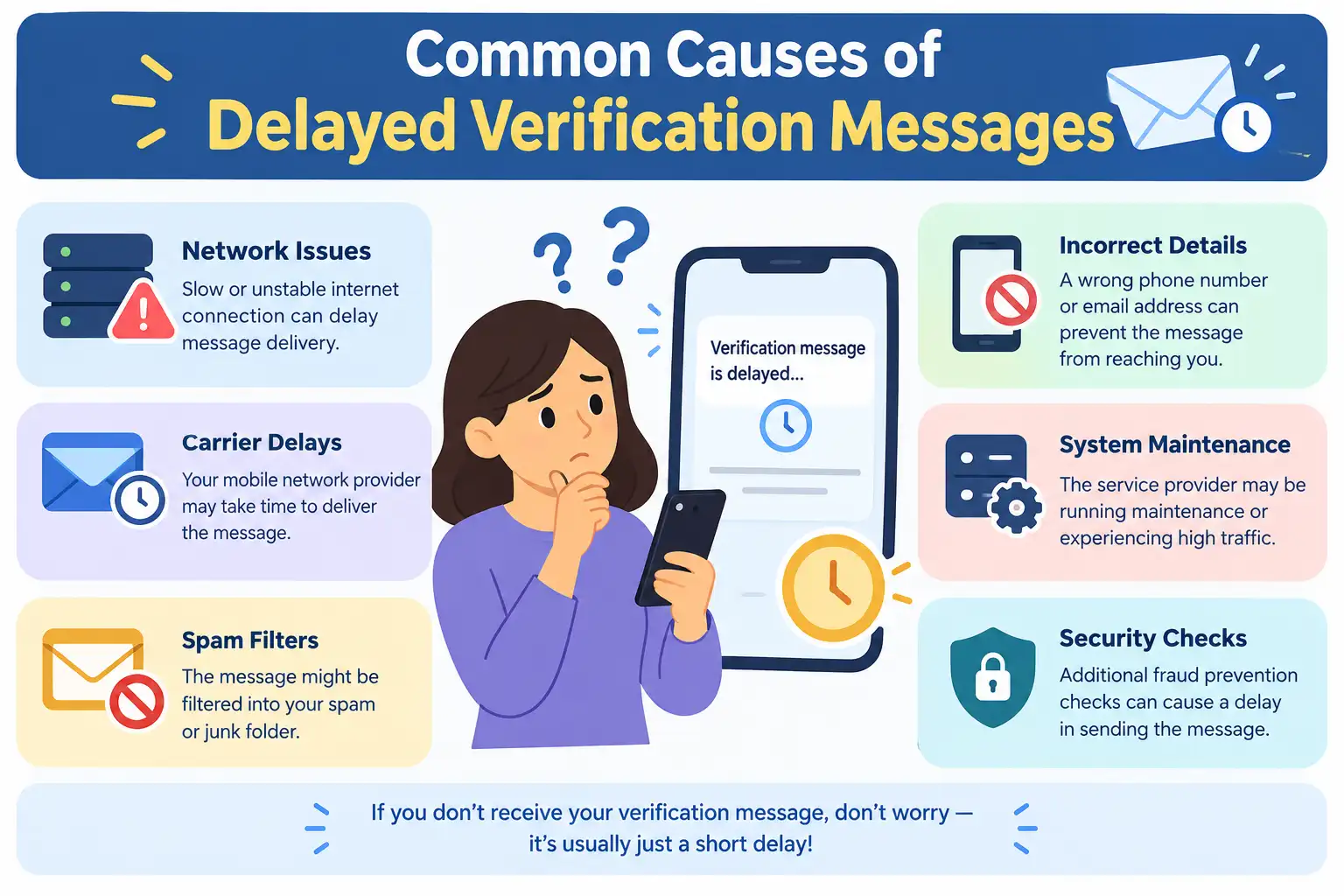
Common Causes of Delayed Verification Messages
1. The format for the country code or number is wrong
Country code is added automatically in some forms. Some need the global number.
For instance if a form already shows a +1 then adding in another +1 will make it illegal. When a digit is unsupported it won’t reach the carrier nor will a request for a duplicated digit.
Give it a shot.
Choose the country yourself.
See if the form already adds the country code.
Type the number exactly as requested.
Please ensure you only submit the request once.
Country code is added automatically in some forms. Some need the global number.
For instance if a form already shows a +1 then adding in another +1 will make it illegal. When a digit is unsupported it won’t reach the carrier nor will a request for a duplicated digit.
Give it a shot.
Choose the country yourself.
See if the form already adds the country code.
Type the number exactly as requested.
Please ensure you only submit the request once.
2. You have been temporarily rate-limited.
Verification systems restrict repeated requests to mitigate abuse minimize automated traffic and limit messaging expenses.
Application may depend upon limit.
The number of your phone.
Your profile
Your gadget
Your internet protocol address.
Your connections.
A signal that communicates a mixture.
Stop asking for codes and just wait as shown by the service. Wait before making one attempt if no period is shown.
Refrain from creating accounts or frequently switching networks to prevent a limit. It might make the activity seem suspicious.
3. The request seemed strange to the sender.
A website may. Delay or reject a message.
Numerous attempts to no success.
Self-directing action.
A sudden change in your location/network.
Resigning time after time.
A number type that is unsupported.
The device and account do not match.
Use your device and network. Complete any security checks presented by the service. Contact the sender’s support if the block persists.
4. Carrier is delaying automated SMS
You can send verification SMS via codes sender IDs or apps. The routes may be treated differently from personal messages.
A carrier may allow message but block one type.
Brief codes.
Global communications.
Messages using software.
Opt for premium messages.
Messages from a specified sender class.
Give this a go: Reach out to your carrier and check whether there’s a block on your line for automated, short-code or international SMS.
Google’s official help documentation on account issues cites the potential for short-code problems and carrier restrictions as causes. View Google’s troubleshooting guidance.
5. The message was moved to a filtered folder
Your phone or messaging application may have received the message but placed it other than the main inbox.
Check:
Spam messages.
Blocked messages.
Unknown senders.
Archived conversations.
The default messaging application on your phone.
If you temporarily change a filtering option for testing restore the protection afterward.
6. The number cannot receive that type of message
A phone number is not automatically compatible with every SMS route. Some lines are:
Voice-
Data-only.
Landlines.
The codes could not be received.
Messages could not be received.
This is subject to plan limitations.
The eSIM only explains how to activate the plan and does not guarantee that the plan will include a phone number or SMS reception.
Try the following: Check the plan details. Contact your service provider before using the number to verify.
7. The service does not accept VoIP numbers.
Websites may categorize phone lines as mobile, landline, fixed VoIP, free non-fixed VoIP, or other types.
Some security measures accept user-controlled mobile phone numbers. In this case, changing your VoIP number is unlikely to help.
Tools like Twilio Line Type Intelligence explain how to identify phone line categories.
Try the following: Read the service's phone number requirements and use a specific type. Do not intentionally try to circumvent any restrictions imposed by the service.
8. This number has been used a lot.
Shared and public phone numbers can be used by multiple people. A website may impose restrictions on a specific number even when the inbox is connected to the internet and receiving messages from other senders.
This means that:
The active inbox may be rejected by the platform.
A certain number may work with one sender but not with another.
Previous activities may affect orders.
If the service explicitly allows the use of temporary numbers, use them only for legitimate, low-risk testing purposes. NeedGetSMS mailboxes are public and shared, so please read the NeedGetSMS Acceptable Use Policy before using the service.
9. You are entering an old code.
If you request a new code, the previous one may no longer be valid. You may receive a delayed notification after the newer code has been used.
Try this:
Compare the timestamps of the messages.
Use the correct code.
Do not combine a code from one session with a code from another session.
Follow the expiry time displayed by the sending service.
10. The sender is experiencing a service interruption.
Sometimes, the phone number and the phone company are working correctly while the website's verification provider is lagging or unavailable.
Try this:
Check the service status page.
Use email or voice verification if available.
Try an authentication app or passcode.
Wait before submitting another request.
A safe arrangement for solving problems
Use this sequence:
First step: Check the number once
- Check the country, country code, and numbers. Avoid editing and sending different copies.
Step two: Wait
- Follow the timer provided by the service. Do not press the resend button multiple times.
Step 3: Check the receiver
- Check your spam, blocked, and unknown sender folders. Make sure your phone line is receiving SMS messages.
Step four: Check compatibility
- Check if the sender accepts your country, telecom company, and line type.
Step 5: Choosing a certified alternative
- Use email, a voice call, an authenticator app, a passcode, or a backup code when available.
Step six: Contact the support team
- Contact the website if your request is rejected or restricted. Contact your service provider if you fail to receive messages from other services. Contact your phone number provider if your email inbox is inactive.
Using Public or Temporary Numbers Responsibly
A inbox is not private. Other visitors may be able to view messages received by the number.
Do not use an temporary number for:
Banking and payment accounts.
Government services.
Healthcare portals.
Employment accounts.
Private communications.
Password resets.
Account recovery.
Cryptocurrency accounts.
Any account that contains personal information.
NeedGetSMS is intended for non-sensitive testing where the third-party service permits temporary or shared numbers. It must not be used to get around authentication defeat -abuse systems create accounts, in violation of another service’s rules or access someone else’s account.
You can also read SMS Authentication Risks and Safer Alternatives.
How Virtual Numbers Differ From Mobile Numbers
A virtual SMS number can get messages using a website of a real SIM card.. Not all virtual numbers are the same.
The number can be one of these types:
Mobile.
Landline.
Fixed VoIP.
Non-fixed VoIP.
Toll-free.
Shared temporary access.
The rules set by the person sending the message decide if the number is allowed. For details read What Is a Virtual SMS Number?.
Do not think that a country code means the number will work.
When to Use a Different Verification Method
Pick a way when:
The service does not accept public or virtual numbers.
The account is important.
The number does not belong to you.
The service has a passkey or an authenticator app.
The message has details.
You are trying to get into an account.
Authenticator apps, passkeys and numbers that you manage are usually safer for accounts than a public SMS inbox.
Our guide on How to Protect Your Privacy Online has tips, about passwords, permissions, phishing and better ways to log in.
Pick a way when:
The service does not accept public or virtual numbers.
The account is important.
The number does not belong to you.
The service has a passkey or an authenticator app.
The message has details.
You are trying to get into an account.
Authenticator apps, passkeys and numbers that you manage are usually safer for accounts than a public SMS inbox.
Our guide on How to Protect Your Privacy Online has tips, about passwords, permissions, phishing and better ways to log in.
Asked Questions
Why does the website say the code was sent when I don't get it?
The website might have taken the request before the message reached the carrier. The message could also be late, blocked or not allowed because of the number type.
Should I keep clicking Resend?
No. Trying times can cause a block and might make old codes stop working. Wait for the allowed time. Try once more if needed.
Can a virtual number get verification SMS?
Some virtual numbers can get verification messages others cannot. If the message is allowed depends on the number type. What the service needs.
Why can I get texts but not verification messages?
Normal texts and automated verification messages might go through paths. Your phone company might allow messages but stop short codes or robot traffic.
Is a public inbox safe?
No. A public inbox can be seen by others. Do not use it for accounts, private info or account recovery.
What should I do if a message has info?
Do not copy, share or click the links. Use the NeedGetSMS Report Abuse page to tell the team about it.
final advice
If you don't receive a verification message via text message, trying again is generally not recommended. Check the number format, wait the allowed time, review your message filters, and ensure the sender supports your number type.
For accounts, use a private number or a more secure login method that you control. Only use temporary, generic numbers for non-private tasks permitted by the service.
Read more
Google Account Help: Troubleshooting Verification and Recovery Messages
Twilio font type intelligence
How to make shared temporary SMS numbers work
Risks of SMS authentication and safer alternatives
What is the default text message number?
How to protect your online privacy
NeedGetSMS Acceptable Use Policy
NeedGetSMS Privacy Policy
Google Account Help: Troubleshooting Verification and Recovery Messages
Twilio font type intelligence
How to make shared temporary SMS numbers work
Risks of SMS authentication and safer alternatives
What is the default text message number?
How to protect your online privacy
NeedGetSMS Acceptable Use Policy
NeedGetSMS Privacy Policy
This article is original editorial content published by NeedGetSMS. It does not provide instructions for bypassing verification or accessing accounts that are not yours. See our Acceptable Use Policy and Privacy Policy.