Spain Phone Number Format (+34): A Practical SMS Form Guide
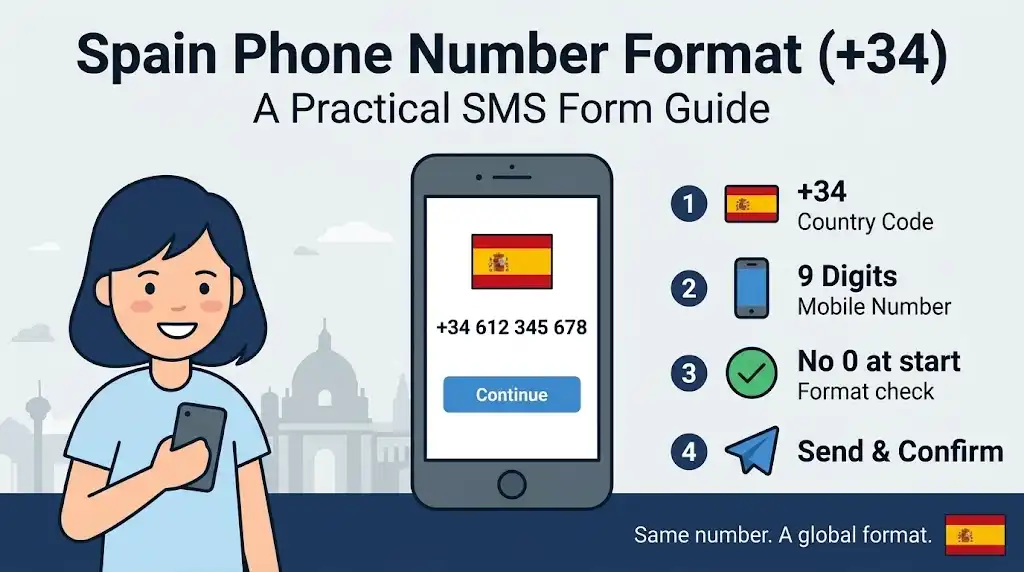
Spain Phone Number Format (+34): Why Adding the Code Isn’t Always Enough
Adding +34 before any number does not always produce a valid international entry, due to the receiving form being particular if it expects just the national significant number, the full international number, or digits without any punctuation. The country code +34 is used in Spain, but the fields have to be programmed accordingly.
Reading the field before you type
The mobile and landline numbers in spain have 9 digits in the national numbering plan, and do not have a trunk prefix, unlike many European countries (Sweden, Australia, etc.), which have a 0 after the country code that also needs to be removed. For Spain, the 9-digit national significant numbers are entered as they are, after the dialing prefix that already has +34 or after +34 in the international input field. So the most common mistake is either using the +34 twice or entering the number with punctuation that gets rejected by the field.
Three checks should be made when entering a number and it is rejected:
- If Spain is selected, the field might have already had +34, so there is no need to enter it again
- If the field specifies that it requires an international number, look at the example and enter the number exactly as it is shown.
- If digits have been entered correctly but the system still does not accept them, check if additional punctuation has been added accidentally, as some fields do not accept brackets or spaces.
| Item | Practical detail |
|---|---|
| Country code | +34 |
| Primary issue | Using the wrong field format |
| Safe test | Permitted, non-sensitive SMS observation |
| Public-inbox limitation | Messages may be visible to other visitors |
What a missing message can mean
Check the country selection and the field’s pattern once again, then allow a certain period of time for the message to be delivered. If it still does not appear, the reason might be that the sender filters out shared or virtual numbers, or the route was down during the sending time. It is better to contact the local carrier directly for the observations of this kind, as the delivery depends on the carrier’s infrastructure, the phone number itself, the sender’s address, and any additional relaying services that might be used by either party.
A missed message does not mean that all Spanish numbers are unusable for your service. Likewise, trying different public virtual numbers in an attempt to work around the filter is not an optimal solution. If the platform has a recommended procedure for observing numbers, adhere to it.
Public virtual number services, such as NeedGetSMS, where a Spanish phone number can be obtained and used for temporary observation, provide shared numbers that may be appropriate for such a task. These are often subject to change, as well as be used by other people, so a shared inbox cannot serve as a reliable source for sensitive messages. It is better to use an allocated number for personal observations rather than a shared one.
Keep important accounts away from a shared inbox
Banking, governmental, health-related, account recovery, and other sensitive services must not be observed from a shared inbox, as other visitors may be able to read these messages. Any personal account should be placed on a private number. A shared inbox is suitable for light observations, but not for services that require a personal account.
See the Spain number page and the ITU numbering reference.
The same principle applies to a public inbox: it can help answer a narrow testing question, but it should not be presented as a way to establish identity or keep control of an account.
For a page intended to help readers, that distinction is more valuable than a long list of platforms. The same country format can be handled differently by different services, so the receiving form remains part of the answer.
This article is original editorial content published by NeedGetSMS. It does not provide instructions for bypassing verification or accessing accounts that are not yours. See our Acceptable Use Policy and Privacy Policy.